
Professional commercial landscaping can increase a property’s value, mainly by strengthening tenant demand, occupancy, and the income the building generates, along with the impression it makes on prospective tenants and buyers.
That value works differently from a home sale, because a commercial asset is priced on how it performs, which is why well-designed grounds are better understood as a driver of appeal and income than as a cosmetic add-on.
The rest of this post examines the details, such as:
- How landscaping influences value
- What curb appeal signals to tenants and buyers
- Why presentation carries higher stakes in the NYC market
- Why the payoff depends on treating landscaping as a long-term investment.
How Commercial Landscaping Influences Property Value
Value for a commercial building largely depends on income and occupancy, so landscaping boosts it indirectly by helping the property attract tenants, retain them, and support higher lease rates. A better-looking, better-kept property tends to lease faster and empty slower, and that steadier income is what a valuation ultimately rewards.
On the income approach that most commercial appraisals rely on, value climbs as net operating income climbs, so anything that lifts achievable rent or trims vacancy feeds almost directly into the figure an appraiser or buyer settles on. Landscaping is one of the few exterior investments that can move both of those levers at once, which is what separates it from a purely decorative expense.
The rent connection is not just intuition. According to a study of office buildings published by the International Society of Arboriculture (ISA), landscaping with good aesthetic value added roughly 7 percent to a building’s average rental rate, and good shade from trees added a similar amount.
The same analysis turned up a twist worth knowing, since landscaping used as a heavy visual screen actually pushed rents down by close to 7.5 percent, which suggests office tenants prize open sightlines and visibility over enclosed privacy.
Read together, those findings all point the same way, because higher rents and lower vacancy compound into a stronger valuation over time. For an owner planning to refinance or sell, that same lift in day-to-day performance is what eventually shows up in the appraisal.
What Curb Appeal Signals to Tenants and Buyers
Two audiences decide what a commercial property is worth, and landscaping speaks to both before either one reads a single number. For a prospective tenant, attractive and well-maintained grounds make the daily experience of arriving at work feel considered, which helps a building win the lease and keep the tenant at renewal.
Retention weighs as heavily as attraction here, because a tenant who renews spares the owner the downtime, fit-out, and broker costs that come with turning a space over, and grounds that still look cared for in year five quietly reinforce the decision to stay.
Buyers and investors read those same grounds as a signal about management, since cared-for landscaping suggests an asset without hidden deferred maintenance, while an overgrown or patchy exterior raises a fair question about what else has been let go behind it.
The perception effect reaches customers too. University of Washington researcher Kathleen Wolf, whose work is mentioned in the same ISA article, found that shoppers reported a willingness to pay around a 12 percent premium for goods in retail districts with quality landscaping. For a retail or mixed-use property, that is a direct line from greenery at the curb to the rents those tenants can afford to pay. That premium ultimately reaches the landlord through the strength of the retail tenancy that the property can attract and keep.
Why NYC Raises the Stakes on Presentation
Space is scarce and competition for tenants is fierce in New York City, which turns a well-designed plaza, entrance, or rooftop into a genuine point of difference rather than a nicety. When two comparable buildings court the same tenant, the one that presents better at street level often wins, which is often the case for professional landscaping in high-traffic areas where thousands of impressions form every day.
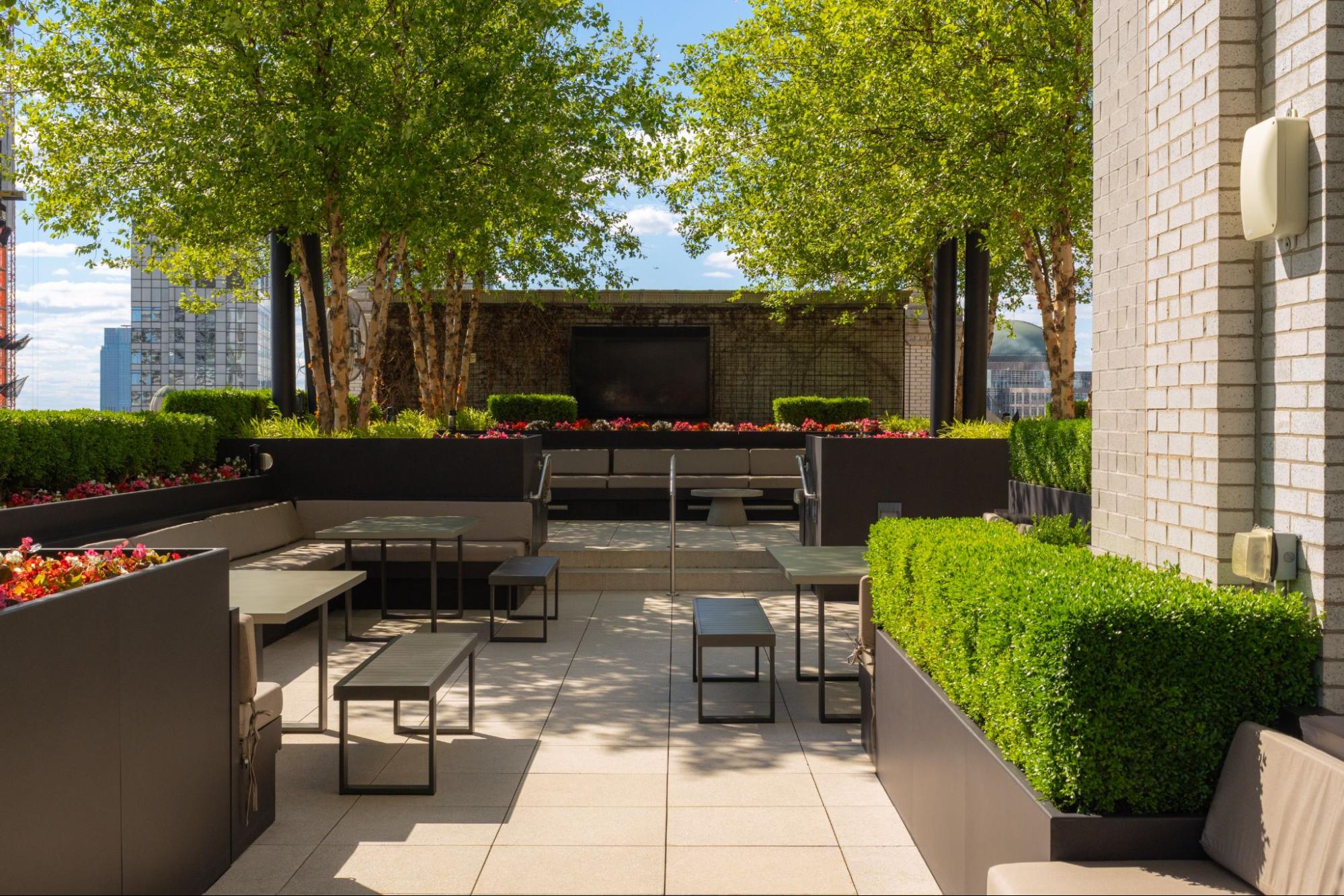
In a market where Class A tenants increasingly expect usable outdoor amenity space, a rooftop terrace or a landscaped courtyard has shifted from a bonus to part of what a competitive lease is measured against, and a tired version of either works against the building. Reaching that standard in this climate takes more than good taste, because plantings have to hold up through the city’s summer heat, channeled wind, and freeze-thaw winters, and installations have to meet local requirements before they ever earn their keep.
An experienced local partner is what keeps that work on the right side of permitting and code the first time, rather than after a costly correction. A property that clears those bars and still looks polished is the one that stands out among the comparable buildings chasing the same tenants and buyers.
- Tip: Cambridge maintains grounds for commercial office and mixed-use properties across NYC, and that portfolio is a large part of what a strong presentation looks like at this level, from lobby-adjacent plantings to rooftop amenity spaces.
A Long-Term Investment, Not a One-Time Cost
Whatever a landscape adds on installation day starts to erode the moment upkeep lapses, so the value it creates is only as durable as the maintenance behind it. Consistent seasonal care, meaning pruning, replanting, cleanup, and health checks on a set schedule, is what protects both the appearance and the financial return the design was meant to deliver.
Smart material choices stretch that return further. Durable, sustainable options such as native plantings and energy-efficient lighting cut down on replacement cycles and lower the lifecycle cost of the landscape over the years, keeping more of the value in the property and less of it in the maintenance line. The math favors steady upkeep for the same reason, since a phased refresh of aging plantings usually costs a fraction of tearing out and redesigning a landscape that has been left to fail, so a small and regular investment is what guards against the far larger reactive one later.
Treating professional commercial landscaping services as an ongoing relationship rather than a one-time project is what keeps a property performing season after season, instead of forcing a scramble every time the grounds slip into visible decline.
Turn Your Landscape Into a Return
Designed and maintained with intent, commercial landscaping supports property value on every front that matters to an owner, through tenant appeal, occupancy, and the long-term returns that follow from both. Left to chance, the same grounds become a liability that quietly works against the asset, so the difference comes down to a plan and the discipline to keep it going.
A first impression built on that kind of care strengthens tenant experience, reinforces the building’s identity, and protects the long-term value an owner is working to grow. Whether landscaping is worth it stops being an abstract question the moment it is weighed against a specific property, its tenants, and its numbers, which is where a professional assessment does its work.
If you want your grounds working for the value of your property rather than against it, we would be glad to help. Contact the Cambridge team to plan a landscape that protects and grows your investment.