Most commercial properties have some form of landscaping, but far fewer have landscaping that actually works for them.
The gap between the two is not always obvious at first. A property might look well-maintained and still fall short by impeding access, failing to hold up through winter, or adding maintenance costs without adding meaningful value. Those outcomes are the exact opposite of what effective commercial landscape design looks like. The real goal is to ensure it functions well, reflects the property’s identity, and holds up over time.
This post covers the core principles we apply when designing commercial landscaping projects for New York City properties, as well as some of the most common mistakes we encounter.
1. Function Comes First
Before any aesthetic decisions are made, effective commercial landscape design begins with understanding how a space is actually used.
Traffic flow, access points, sight lines, and safety requirements all shape what a design can and cannot achieve. In high-density urban properties, the same outdoor space is often shared by tenants, visitors, delivery personnel, and maintenance crews, sometimes simultaneously.
In New York City, that complexity is compounded by dense foot traffic, proximity to public sidewalks, and city regulations around sidewalk clearance and streetscape upkeep.
2. Unity and Visual Cohesion
Unity is the quality that makes a property’s landscaping appear intentional rather than accumulated over time.
It is achieved through consistent plant palettes, materials, scale, and color across a site. In commercial settings, visual cohesion extends beyond individual planting beds to entrances, common areas, plazas, and rooftops. Ideally, every zone should feel like part of the same design, even when different areas serve different purposes.
A lack of unity is one of the most common issues we encounter on properties that have added landscaping incrementally over the years without a guiding plan. The result is a patchwork of styles and materials that can read as neglected or overwhelming.
Ultimately, unity requires a site-wide perspective from the outset, not just attention to individual beds or zones.
3. Scale, Proportion, and the Urban Environment
Commercial landscape design in New York City demands a precision around scale and proportion that residential work rarely requires at the same level.
Plant and hardscape selections must be proportional to the building’s footprint, facade height, and surrounding streetscape. Oversized plantings can overwhelm an entrance and obstruct sight lines. Undersized ones disappear against a large facade and fail to register at all.
New York City’s urban density adds a further layer of constraints: limited soil depth, proximity to underground infrastructure, wind tunnels between buildings, and reduced natural light all factor into what will realistically thrive in a given location.
Getting scale right cannot be resolved by browsing a catalog and requires a thorough site assessment before any plant or material is chosen to identify a building’s specific environmental conditions.
4. Seasonal Continuity and Year-Round Performance
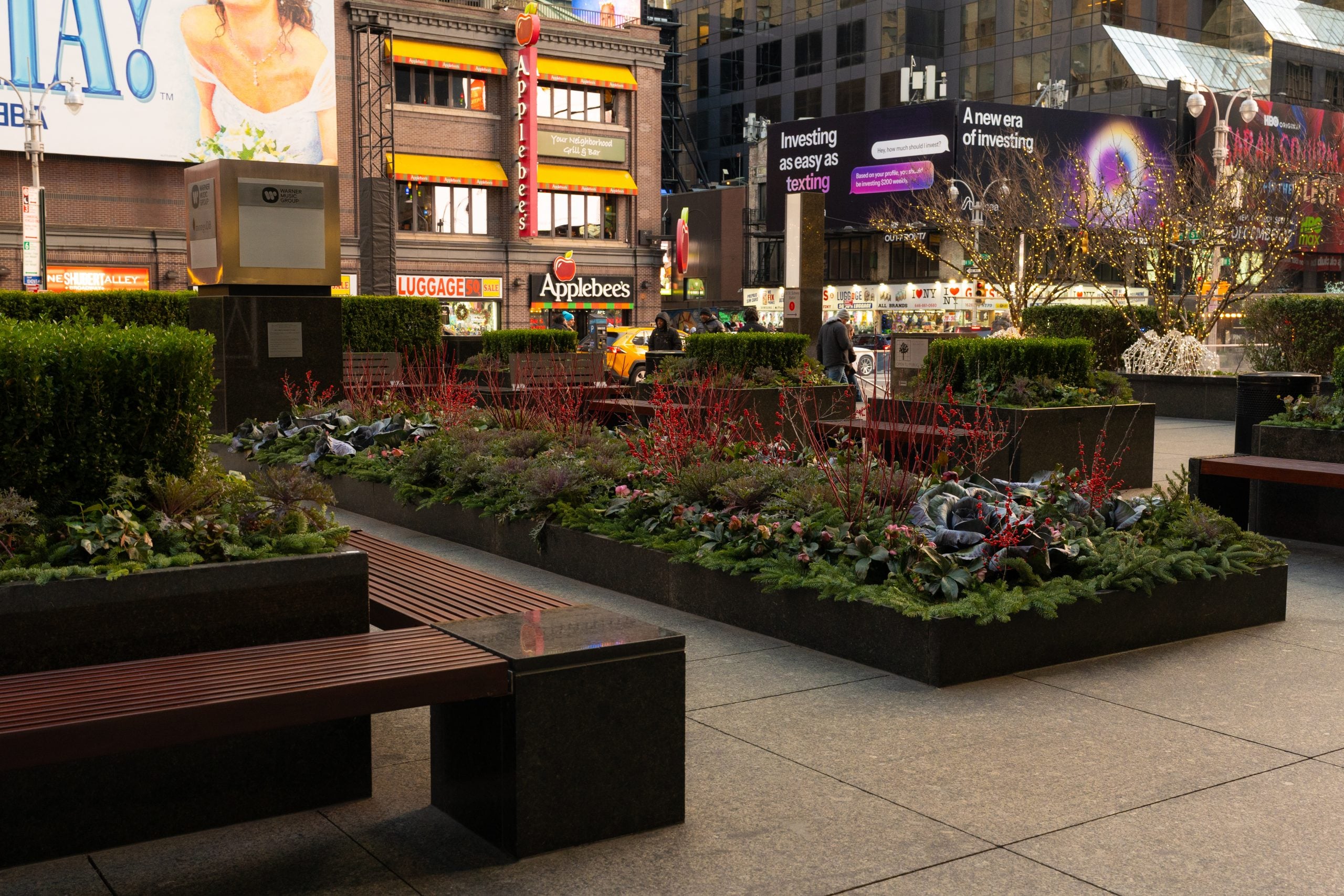
For NYC landscapes, there are months when it’s particularly difficult to make things look good, and that challenge has to be accounted for in advance.
Seasonal continuity is achieved through layered planting strategies, with species selected to provide visual interest across spring, summer, fall, and winter.
A property that relies entirely on warm-weather plantings will go completely dormant from November through March. Hardy structural plants, evergreens, and well-chosen hardscape elements ensure the property retains a sense of care and intention through the coldest months.
The coldest months reveal a landscape’s true structural integrity, as thoughtfully arranged hardscapes and enduring plant selections retain their visual intent long after flowers fade.
For guidance on building a resilient plant palette, our post on landscaping plants that work year-round is a useful reference.
5. Sustainable Design
For commercial properties, sustainable landscape design is an increasingly practical consideration with real financial and regulatory implications.
Native and adaptive plant species require less water, fewer chemical inputs, and less intervention to thrive in local conditions. Over time, that translates into lower maintenance costs and a more resilient landscape that recovers more quickly from seasonal stress. In NYC, sustainable design also intersects with green infrastructure priorities.
Among the most relevant considerations for building owners and property managers are the following:
- Permeable surfaces and managed plantings that help reduce the stormwater runoff load on city infrastructure
- Strategic tree canopy and green cover that can mitigate urban heat island effects in dense neighborhoods
- Rooftop and terrace plantings that may support LEED certification or compliance with NYC Local Laws 92 and 94 (which require green roofs or solar panels on qualifying new construction)
Properties pursuing sustainability certifications benefit most when landscape design is planned with those goals in mind from the start, as opposed to retrofitting once construction is complete.
6. Realistic Maintenance Requirements
Every landscape design carries an implicit commitment about what ongoing maintenance will look like. The question is whether that commitment is realistic.
A landscape that requires intensive upkeep to look its best is a design risk. When maintenance is deferred—which happens on virtually every commercial property at some point—the property will be visually compromised. Plant selections, hardscape materials, and irrigation systems all have direct implications for ongoing maintenance costs and labor requirements.
7. Brand Alignment and Tenant Experience
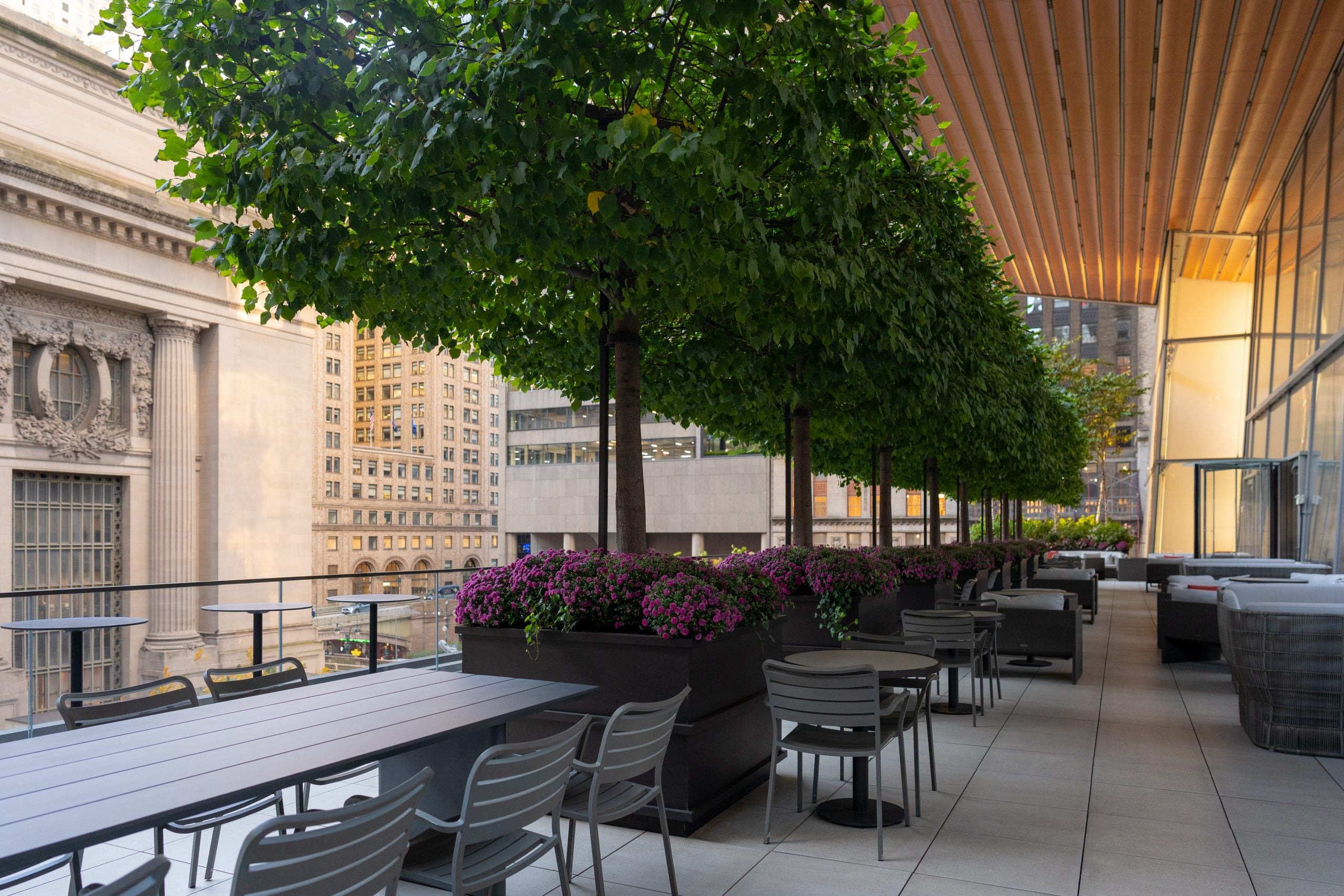
The exterior of a commercial property communicates its standard of care before anyone walks through the door. Landscaping is a central part of that signal.
For multi-tenant buildings, well-designed outdoor spaces are a tangible amenity. Building managers who prioritize tenant retention find that landscape quality becomes part of the conversation during renewals. Well-maintained grounds reduce perceived vacancy, reinforce the space’s value, and create an environment that tenants want to return to each day.
Design choices, including plant varieties, hardscape finishes, lighting, and seasonal programs, can be calibrated to reflect a building’s specific positioning. A property aiming for a premium feel calls for different design decisions than one focused on sustainability credentials or approachability. The landscape is an extension of the building’s brand, and treating it as such from the design stage yields a more coherent result.
For a closer look at the financial side of that investment, Does Commercial Landscaping Increase Your Property Value? covers the evidence in detail.
Good Design Doesn’t Happen by Accident
The most effective commercial landscapes are integrated systems in which function, aesthetics, and long-term maintenance work together without requiring constant intervention to keep them in place.
The principles covered here, from function and unity to scale, sustainability, and brand alignment, are the starting point for every project we take on. They apply whether the scope is a single building entrance in Midtown or a full campus redesign in the outer boroughs.
If your NYC property’s current landscaping is not performing the way it should, or if you are planning a new commercial landscape design and want to get it right from the start, we would be glad to help. Contact the team today to request a quote.